Tel \ WhatsApp
+1(626)866 1909
+86 185 2005 0589

Author: Site Editor Publish Time: 2026-08-13 Origin: Site

The unboxing experience remains a jewelry brand’s most critical physical touchpoint. Customers judge your pieces instantly based entirely on their first physical interaction. Yet, packaging procurement often lures businesses into a frustrating trap of hidden costs and supply chain delays.
Selecting the right container demands a strategic balance between unit economics, brand positioning, and logistical feasibility. A poor choice in materials or sizing can rapidly drain profit margins. Misaligned packaging designs also risk damaging your hard-earned reputation before the buyer even sees the product.
This comprehensive guide breaks down the precise evaluation criteria for designing, budgeting, and sourcing packaging. You will learn how to secure premium materials and reliable suppliers seamlessly. We ensure you can navigate this complex process without ever sacrificing product margins or brand credibility.
Packaging budgets should typically align with 2–5% of the jewelry’s retail value, heavily influenced by minimum order quantities (MOQs) and material choices.
The right jewelry packaging box material—whether rigid paperboard, wood, or velvet—must be evaluated on dimensional weight for shipping, not just aesthetic appeal.
Security and compliance (e.g., anti-tarnish inserts, FSC-certified papers) are non-negotiable evaluation metrics for high-end and eco-conscious brands.
Supplier shortlisting requires testing physical prototypes for hinge durability, insert fit, and print alignment before committing to full-scale production.
Establishing baseline cost assumptions requires a deep understanding of your product tiers. Costume and fashion jewelry brands often operate on tighter margins. They must seek scalable, lightweight containers. Conversely, fine jewelry allows for a higher initial investment. Consumers expect luxury materials matching the high price point of engagement rings or diamond bracelets. A safe industry baseline sets packaging budgets at roughly two to five percent of the total retail value.
You must also evaluate the unboxing return on investment. Specific elements drive customer retention and organic social sharing. A satisfying magnetic closure snap creates an instant feeling of quality. Custom sleeves offer additional branding real estate. These small touches encourage buyers to film unboxing videos. Organic sharing drastically lowers your customer acquisition costs over time. The right Jewelry Packaging Box becomes a silent ambassador for your brand.
Navigating the scale gap between small businesses and enterprise operations presents unique challenges. Small businesses frequently face painfully high minimum order quantities. They must utilize semi-custom solutions to survive. Stock boxes featuring foil-stamped logos provide a premium look without the prohibitive setup fees. Enterprise brands, however, can leverage their high volume. They absorb fully bespoke tooling costs easily. This allows them to create completely unique structural shapes and proprietary textures.
Your choice of material impacts everything from perceived value to final-mile shipping rates. Brands must look beyond pure aesthetic appeal. You have to consider durability, weight, and environmental impact.
Rigid paperboard remains an incredibly popular choice. It offers high structural integrity. It is also highly customizable for complex printing techniques. E-commerce brands favor rigid paperboard because it balances a premium feel against manageable shipping weights. However, paperboard is susceptible to moisture damage during extended ocean transit. You must ensure proper desiccant use during shipping.
Premium tiers often require wood and leather constructions. These materials deliver maximum perceived value and incredible durability. A wooden container often functions as a permanent keepsake for luxury watches or engagement rings. The downside involves significant dimensional weight penalties. Furthermore, rigid materials require strict quality control for hinges and metal clasps to ensure smooth operation over decades.
Velvet and microfiber offer a highly classic aesthetic. They provide excellent scratch protection for delicate stones. Unfortunately, lower-grade velvet accumulates dust rapidly. It can also create a dated perception among modern consumers. Brands must specify high-density, premium microfiber to maintain a contemporary luxury feel.
Sustainability acts as a non-negotiable metric for modern consumers. You must audit materials for verifiable eco-claims. Look for FSC-certified paper, soy-based inks, and biodegradable inserts. Avoid accepting vague green marketing from suppliers. Demand actual certification documents. Genuine eco-friendly designs often utilize lighter materials, reducing your overall freight expenses.
Material Comparison Chart
Material Type | Primary Benefit | Major Drawback | Ideal Use Case |
|---|---|---|---|
Rigid Paperboard | Highly customizable and lightweight | Vulnerable to high humidity | E-commerce fashion and mid-tier jewelry |
Wood & Leather | Maximum durability and keepsake value | Heavy, increasing freight costs | Fine jewelry and luxury timepieces |
Velvet & Microfiber | Superior scratch protection | Attracts dust easily if low grade | Classic presentation and retail displays |
Moving beyond generic foam inserts is critical for high-end presentation. Generic foam feels cheap. It also fails to secure intricate pieces properly. Brands must evaluate molded pulp, custom-cut EVA, and velvet-lined cards. A precise insert prevents chain tangling during turbulent transit. It also stops heavy pendants from shifting and damaging delicate stones.
Anti-tarnish technologies are essential for specific metals. Silver and brass pieces oxidize quickly when exposed to certain environmental factors. Assessing the necessity of anti-tarnish fabric linings mitigates expensive return rates. Many luxury brands embed active anti-tarnish tabs directly into the interior lining. This proactive approach preserves the brilliant shine of the jewelry, guaranteeing a flawless unboxing moment.
Transit-tested durability dictates your final structural design. Direct-to-consumer shipping demands rigorous crush resistance. A container must survive rough handling through multiple postal hubs. Retail bag handoffs require less crush resistance but demand higher visual perfection. Establish a clear framework for drop-test performance. Simulate the exact journey your product takes. If your beautifully designed container fails the drop test, it ultimately fails the customer.
Many brands fall into volume pricing traps. Tooling costs and setup fees front-load expenses on custom orders. A supplier might quote an incredibly low per-unit price. However, they may hide massive custom mold fees in the fine print. You must demand a transparent breakdown of all initial setup charges before committing. Sometimes, paying a slightly higher unit price on a semi-custom design saves thousands in upfront tooling.
Mapping realistic lead time timelines prevents catastrophic launch delays. Brands often underestimate the friction involved in mass manufacturing.
Design and Ideation: Finalizing the structural dielines and artwork files.
Prototyping and Revisions: Creating the initial physical sample and adjusting tolerances.
Mass Production: Procuring raw materials, printing, and assembling the final units.
Freight Transit: Moving goods from the factory to your fulfillment center.
You must highlight the stark difference between air freight and sea freight. Air freight delivers goods in days but destroys profit margins. Sea freight keeps unit costs low but requires up to forty days of transit time. Plan your inventory replenishments exclusively around sea freight schedules to protect profitability.
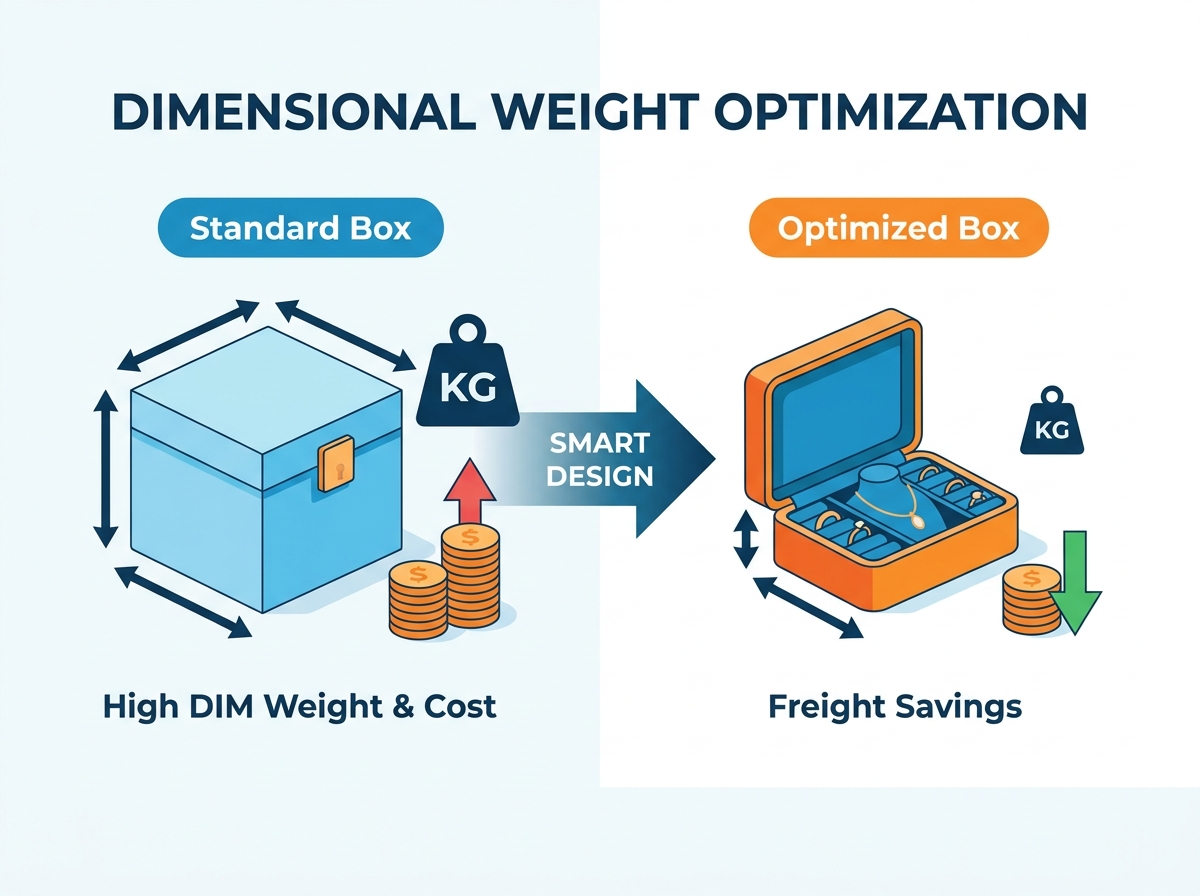
Dimensional weight optimization is your secret weapon. Carriers calculate shipping costs based on box volume, not just actual weight. Calculating how a mere one-inch reduction in packaging size impacts costs is eye-opening. Shaving a fraction of an inch off the exterior dimensions compounds into massive freight savings. It also significantly lowers final-mile delivery costs via carriers like FedEx or UPS.
Never skip the prototype mandate. A pre-production physical sample is strictly required before mass production begins. Digital proofs lie. You must verify actual color-matching under natural light. You need to check logo alignment physically. Most importantly, you must test the insert tolerances. Place your actual jewelry inside the prototype. Shake it vigorously. If the piece falls out, the insert needs immediate revision.
Factory auditing criteria separate reliable partners from risky middlemen. Ask hard questions regarding their quality control processes. Request their historical failure rates. Inquire about their in-house capabilities. A factory printing and assembling under one roof controls quality better than one outsourcing the printing. Furthermore, request their social compliance certifications. Ethical manufacturing is paramount for modern brand credibility.
Identifying red flags in early quotations saves you from future legal and financial headaches. Watch out for these specific warning signs:
Vague material specifications (e.g., listing "paper" instead of "1200gsm rigid board").
Omitted or confusing freight terms, blurring the line between FOB and DDP pricing.
Unrealistic lead time promises designed merely to win your initial deposit.
Refusal to provide previous client references or physical swatch kits.
Vetting suppliers thoroughly ensures your chosen Jewelry Packaging Box arrives precisely as envisioned, on time, and within budget.
Sourcing the perfect container is an ongoing exercise in mitigating risk while maximizing brand presentation. Every structural decision impacts your bottom line. Every material choice influences your customer’s perception. By carefully navigating design requirements and procurement realities, you build a resilient, profitable unboxing experience.
Take immediate action to optimize your current strategy. First, audit your existing packaging dimensional weight to uncover hidden shipping savings. Next, establish a firm per-unit budget based on the two-to-five percent rule. Finally, request material swatch kits and physical samples from three shortlisted suppliers. Rigorous testing today prevents costly manufacturing disasters tomorrow.
A: Standard minimum order quantities vary heavily by customization level. Semi-custom stock options typically require only 100 to 500 units. These usually involve adding foil stamping to existing inventory. Fully bespoke designs require custom molds and tooling, pushing MOQs to start between 1,000 and 3,000 units.
A: Preventing tangling requires specific insert engineering. You must utilize dual-slit inserts at the top to anchor the chain securely. Additionally, incorporating a rear-pouch design behind the insert board stores the excess chain tightly, eliminating any movement or knotting during transit.
A: Raw material costs for sustainable options are often 10 to 15% higher than traditional non-recyclable alternatives. However, eco-friendly designs frequently utilize lighter-weight materials like molded pulp. This weight reduction often offsets the initial material premium through significantly reduced freight and shipping fees.
A: A realistic timeline spans several months. Expect 2 to 3 weeks for initial sampling and revisions. Mass production requires 15 to 30 days. Finally, transit takes 5 to 10 days for air freight, or 30 to 40 days for cost-effective sea freight.
