Tel \ WhatsApp
+1(626)866 1909
+86 185 2005 0589

Author: Site Editor Publish Time: 2026-11-01 Origin: Site

Procurement and brand managers face a constant trade-off when sourcing premium bulk packaging. You must maintain a high-end unboxing experience while controlling exorbitant inbound freight and warehousing costs. Traditional set-up boxes deliver uncompromising luxury. However, they consume massive pallet space and inflate logistics budgets rapidly. Fold-flat alternatives solve this volume issue beautifully. Yet, they introduce new variables on the fulfillment line.
This guide breaks down the financial realities, structural differences, and fulfillment impacts of both options. We will explore how dimensional weight penalties affect your bottom line. You will also learn how manual assembly times impact warehouse velocity. Ultimately, this analysis equips you to make a data-backed procurement decision. By weighing these operational factors carefully, you can protect your margins without sacrificing customer satisfaction.
Fold-flat designs can reduce inbound shipping volume and warehouse footprint by up to 70-80% compared to pre-assembled boxes.
The primary trade-off for fold-flat packaging is fulfillment labor; assembling a foldable unit typically adds 10 to 20 seconds per order.
A well-engineered magnetic rigid gift box offers near-parity in brand perception to traditional set-up boxes, provided the chipboard thickness and hinge mechanisms are specified correctly.
Total Landed Cost (TLC) calculations must include unit price, inbound freight, warehouse storage fees, and assembly labor to accurately compare the two formats.
Understanding the fundamental engineering behind each format is crucial before calculating costs. Factories build both styles from similar core materials. They primarily utilize heavy-duty chipboard wrapped in premium art paper or specialty textured stocks. The difference lies entirely in the final construction phase.
Traditional rigid paper packaging boxes are manufactured and glued into their final three-dimensional shape right at the factory. These units ship completely "hollow." The manufacturer wraps the paper tightly around fixed ninety-degree corners. This creates an incredibly sturdy, non-collapsible shell. Brands love them because they require zero assembly upon arrival. Workers simply take off the lid, drop the product inside, and ship it out.
Conversely, a foldable rigid gift box relies on specialized engineering. Manufacturers score the internal chipboard using deep v-grooves. These grooves act as flexible hinges. The unit ships completely flat to your facility. Fulfillment teams then assemble them on-site. Workers fold the side panels upward, locking them into place. Factories achieve this locking mechanism using either double-sided adhesive strips on the corners or hidden internal magnets. This clever design provides the look of a traditional container while collapsing down to a fraction of its assembled height.
Both formats support high-end finishing techniques. You can apply foil stamping, embossing, and spot UV coating to either style equally well. The decision rarely hinges on aesthetic limitations. Instead, it comes down to logistical efficiency.
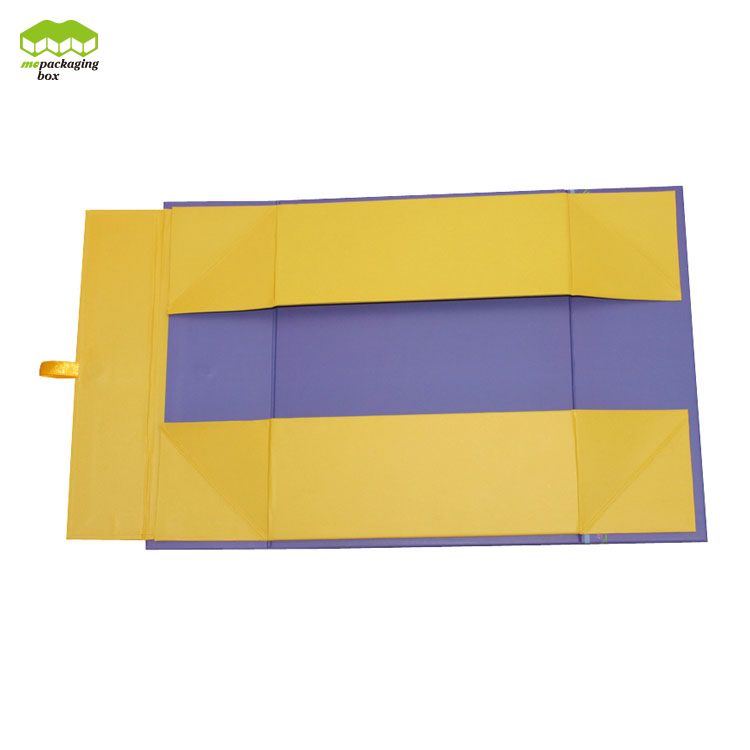
Logistics expenses often dictate the final packaging choice. Shipping carriers and freight forwarders do not charge solely based on actual weight. They utilize a metric called Dimensional Weight (DIM). This formula calculates the volume a package occupies inside a truck or cargo container. Traditional set-up units are essentially boxes of empty air. Because they cannot collapse, they trigger massive DIM weight penalties. Sourcing these containers overseas amplifies this problem exponentially.
Pallet density metrics highlight this disparity clearly. A standard wooden shipping pallet has strict height and footprint limits. You might fit roughly 300 fully assembled set-up boxes on a single pallet. If you switch to a fold-flat design, that same pallet can hold upwards of 1,500 units. This dramatic density increase slashes your inbound ocean or air freight costs immediately.
Beyond transit, warehouse footprint presents a major ongoing expense. Third-Party Logistics (3PL) providers charge monthly fees per pallet position. Reducing your pallet count by 80% means your monthly storage bill drops proportionally.
Table 1: Storage and Pallet Density Comparison
Logistics Metric | Set-Up Rigid Boxes | Fold-Flat Rigid Boxes | Net Impact |
|---|---|---|---|
Units Per Standard Pallet | ~300 units | ~1,500+ units | 5x Density Improvement |
Ocean Freight Space (CBM) | High Volume | Low Volume | Significant Freight Savings |
3PL Monthly Storage Fees | High (Many Pallet Positions) | Low (Fewer Pallet Positions) | Up to 80% Cost Reduction |
In-Transit Damage Risk | Moderate (Crushing risk) | Low (Flat stacking) | Better Yield per Shipment |
However, you must implement basic risk mitigation. Flat units require specialized protective outer shipping cartons. Heavy stacks can warp the rigid boards during transit if moisture levels fluctuate. Always specify heavy-duty, multi-wall corrugated master cartons from your supplier to protect your flat-packed inventory.
Transitioning to flat designs shifts the assembly burden away from the overseas factory. It places that burden squarely onto your domestic warehouse team. This introduces a hidden cost. You must account for assembly labor when calculating your overall margins.
Building a collapsible unit takes time. A trained worker typically needs 10 to 20 seconds to peel adhesive strips, fold the panels, and secure the corners. This sounds minimal in isolation. However, if your facility processes 2,000 orders daily, those seconds compound into hours of additional labor. During peak seasonal rushes, this extra operational step can create severe bottlenecks.
Traditional formats offer superior fulfillment velocity. They provide ultimate "drop-and-pack" efficiency. Workers grab the container, insert the item, and seal it instantly. To determine if the space savings justify the slower packing speed, brands must evaluate their operations rigorously.
We recommend conducting a time-motion study on your packing line. Follow these specific steps to gather accurate data:
Define your baseline packing speed using your current pre-assembled containers.
Introduce a prototype flat-pack unit and record the manual folding phase across fifty trials.
Calculate the average labor variance per individual order.
Multiply this variance by your average hourly warehouse wage.
Model the data against your peak holiday volume to identify potential bottlenecks.
If the inbound freight savings exceed the projected spike in labor costs, the flat format wins financially. If you run a highly automated, high-speed line, the manual folding step might prove too disruptive.
Many brand managers initially worry about unboxing quality. They fear flat-pack designs might feel flimsy or cheap to the end consumer. Early iterations of collapsible containers did suffer from weak adhesives and visible seams. Modern engineering has largely eliminated these concerns.
Today, a premium magnetic rigid gift box provides a sophisticated experience. When the customer opens the flap, hidden magnets release. When they close it, the magnets pull together, creating a satisfying auditory "snap." This tactile feedback mimics the luxury feel of a traditional set-up container. In some cases, the sleek magnetic flap actually elevates the perceived value.
Structural integrity remains an important differentiator. Set-up boxes generally offer superior rigidity for heavy items. The glued, fixed corners distribute downward pressure exceptionally well. If you ship heavy glass liquor bottles or large cosmetic jars, the traditional rigid format provides maximum protection. The fixed walls prevent lateral shifting during rough transit.
Collapsible boxes serve different product categories perfectly. They are excellent for luxury apparel, lightweight cosmetics, jewelry, and influencer PR kits. The hinged corners handle moderate weight easily. However, if you plan to house heavy, fragile goods, rigorous drop-testing is mandatory. You must ensure the magnets or adhesive strips will not burst open upon impact.
Always specify an appropriate chipboard thickness. A 1200gsm (grams per square meter) board offers standard durability. Upgrading to a 1500gsm or 1800gsm board provides maximum rigidity for collapsible designs, ensuring they feel substantial in the customer's hands.
Neither style is universally perfect. Your choice depends entirely on your specific supply chain dynamics. You must analyze where your business incurs the most operational friction. We use a standardized framework to help procurement teams categorize their needs.
Sourcing locally: If your manufacturer is located near your fulfillment center, short transit distances minimize DIM weight penalties.
Ultra-luxury constraints: When packaging heavy, high-value items requiring 100% flawless structural rigidity and zero visible seams.
High-speed fulfillment: If your warehouse utilizes automated lines with zero tolerance for manual folding tasks.
Small batch runs: When ordering limited quantities where freight optimization is less critical.
Sourcing overseas: When crossing oceans, the massive reduction in air and sea freight volume saves substantial capital.
Space constraints: If your facility has a limited warehouse footprint or you face aggressive 3PL storage rate hikes.
Labor buffer: When your fulfillment Service Level Agreements (SLAs) allow a slight manual assembly buffer per order.
High-volume scaling: When rapid growth demands moving thousands of units efficiently across international borders.
Chart: Packaging Format Selection Matrix
Business Priority | Recommended Format | Primary Justification |
|---|---|---|
Minimizing Freight Spend | Fold-Flat | Avoids excessive DIM weight charges. |
Maximum Packing Speed | Set-Up | Requires zero manual assembly steps. |
Reducing Storage Footprint | Fold-Flat | Increases pallet density by up to 500%. |
Housing Heavy/Fragile Goods | Set-Up | Provides superior fixed-corner structural support. |
Your next step requires practical testing. Request physical prototypes of both formats from your manufacturer. Next, run a 50-unit assembly test utilizing your actual warehouse team. Record the metrics accurately. Finally, calculate your Total Landed Cost (TLC). You must add the unit price, inbound freight bill, projected storage fees, and the calculated assembly labor. This comprehensive equation reveals the true financial winner.
Selecting the optimal bulk packaging format requires balancing presentation against logistics. Neither box type proves universally superior. The correct choice depends entirely on where your business experiences the most friction. You must evaluate whether exorbitant freight and storage costs outweigh the burden of fulfillment labor.
Traditional set-up designs remain the gold standard for high-speed packing and heavy item protection. However, they strain logistics budgets relentlessly. For high-volume, internationally sourced bulk packaging, the foldable format usually emerges as the more scalable financial choice. You gain massive pallet density and slash DIM weight penalties. Provided you invest in high-quality materials and magnetic closures, you will easily protect the premium brand experience your customers expect. Evaluate your operations, run a time-motion study, and let the Total Landed Cost guide your final procurement strategy.
A: No. They accommodate the exact same custom die-cut foam or molded pulp inserts used in traditional rigid formats. You simply store these inserts separately. Fulfillment teams place them inside during the final assembly stage. This maintains perfect product presentation while preserving flat-shipping benefits.
A: Magnets do complicate traditional recycling streams. Most municipal facilities cannot process embedded metals easily. However, these premium containers excel at secondary reuse. Consumers frequently repurpose them for home storage, keepsakes, or regifting. This extended lifecycle offsets initial environmental impacts significantly by keeping the material out of landfills.
A: Minimum quantities remain quite similar across both formats. Manufacturers usually require 500 to 1,000 units depending on customization levels. However, fold-flat designs let you maximize your shipping budget. You can often order a larger bulk quantity without triggering excessive freight costs.
