Tel \ WhatsApp
+1(626)866 1909
+86 185 2005 0589
+86 138 1119 0095

Author: Site Editor Publish Time: 2026-11-07 Origin: Site

A successful tea product launch requires more than a high-quality blend. It demands packaging engineered specifically for your target retail environment. You must capture shopper attention instantly while protecting the delicate flavors hidden inside. At the critical decision stage of procurement and brand strategy, selecting the right packaging involves aligning structural format with visual artwork. Brands often struggle to balance shelf space constraints, unit economics, and complex supply chain realities. Ignoring these logistical factors can lead to damaged products, wasted shelf space, or poor sales performance. This comprehensive guide breaks down the essential criteria for evaluating tea packaging options. We will explore how to mitigate structural risks and optimize your visual artwork effectively. By the end, you will understand how to ensure your final design drives retail conversions while protecting your profit margins.
Retail context dictates structure: Shelf dimensions, lighting, and competitor adjacency must drive the physical footprint of your packaging before artwork begins.
Format determines margin: The choice between flat-pack folding cartons and pre-assembled rigid boxes fundamentally alters shipping costs and fulfillment speeds.
Premiumization requires functional elegance: High-end formats must balance aesthetic unboxing experiences with practical compartmentalization to prevent flavor cross-contamination.
Compliance is non-negotiable: Artwork must balance visual brand hierarchy with strict regulatory requirements for ingredient and origin disclosures.
You must evaluate standard grocery gondolas against boutique counter displays before finalizing your structural dimensions. Retail environments impose strict physical limits on product presentation. Gondola shelves in large grocery chains typically measure 16 to 24 inches deep. Your packaging must maximize vertical billboard space to catch the shopper's eye without exceeding standard shelf depths. Tall, narrow boxes often perform better in crowded aisles. Conversely, boutique counters favor horizontal, spread-out designs. You should adjust your footprint based on where the product will live.
Lighting significantly alters how consumers perceive your material choices. Big-box retailers rely heavily on bright, overhead fluorescent lighting. This harsh light creates massive glare on high-gloss UV coatings. Glare renders your typography unreadable from a distance. If you sell in these environments, uncoated kraft paper or matte finishes absorb light and maintain readability. High-end boutiques often use warm LED spotlights. These directional lights highlight embossed textures and metallic foil beautifully. You must match your substrate and finish to the specific lighting conditions of your target retailer.
A visual audit of the competitor aisle is mandatory. You need a clear framework to assess competitor adjacency. Stand in the physical retail aisle and analyze the dominant color palettes. If every competing brand uses earthy greens and browns, you should deploy contrasting colors to disrupt visual homogeneity. A bright crimson or deep navy box stands out instantly. Sometimes, structural novelty offers the best disruption. If the shelf features endless rows of square cartons, introducing a hexagonal or cylindrical tube breaks the visual monotony. Always design your exterior to counter the established norms of your specific shelf neighbors.
Choosing the correct structural format defines your operational efficiency. Standard folding cartons represent the most scalable option for mass-market retail. We evaluate these based on board grade and assembly speed. Solid Bleached Sulfate (SBS) board offers a pristine white surface ideal for vibrant printing. Kraft board communicates a natural, eco-friendly ethos. Auto-bottom assembly designs snap into place instantly. This drastically reduces manual labor during fulfillment. Furthermore, folding cartons ship flat. This flat-pack efficiency minimizes freight costs from the manufacturer to your facility.
You can explore standard tea packaging boxes to see how folding structures balance cost and durability. Sometimes, folding cartons alone cannot protect delicate ingredients. You must assess the necessity of inner foil or poly-pouches.
Hybrid structures combine an outer paperboard box with an inner sealed pouch. Paperboard provides zero barrier against oxygen and moisture. Tea leaves degrade rapidly when exposed to humidity or ambient air. An inner foil pouch provides the necessary Oxygen Transmission Rate (OTR) barrier. However, adding an inner pouch impacts your outer box dimensions. The box must accommodate the bulky, irregular shape of a filled bag. You must calculate this extra volume carefully to avoid bulging cartons.
Feature | Folding Cartons (Standard) | Hybrid Structures (Box + Pouch) |
|---|---|---|
Primary Use Case | Individually wrapped tea bags | Loose-leaf teas, sensitive herbal blends |
Barrier Protection | Low (requires wrapped bags) | High (foil prevents moisture/oxygen entry) |
Assembly Speed | Fast (especially auto-bottom styles) | Moderate (requires two packing steps) |
Shelf Life Impact | Shorter if bags are unsealed | Extended significantly by inner pouch |
Shortlisting the right vendor ensures your design functions properly in the real world. You must evaluate packaging partners based on specific technical capabilities. Follow this numbered evaluation process when vetting suppliers:
Accurate Dieline Creation: The vendor must provide precise vector dielines. Faulty dielines lead to misaligned artwork and folding errors on the production line.
Structural Prototyping: They must produce physical, blank samples. You need these to test assembly speed and product fit before approving mass production.
Color-Matching Consistency: Your vendor must demonstrate strict color management. They need to match your Pantone colors consistently across different substrates, from SBS board to uncoated kraft.
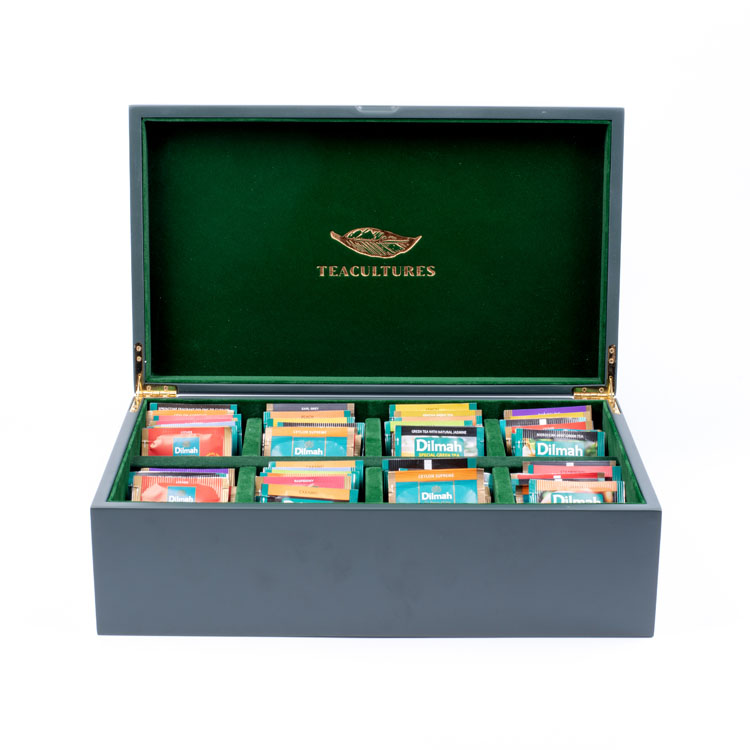
Premium formats demand a higher initial capital investment. However, they allow for massive retail markups. A well-designed tea bag gift box transforms a simple beverage into a luxury experience. You must evaluate the return on investment for these formats carefully. They perform exceptionally well for holiday collections, corporate gifting programs, and flagship product lines. Consumers willingly pay a premium for packaging they can present directly as a gift. The aesthetic unboxing experience justifies the elevated unit cost.
Structural integrity defines the luxury feel. A flimsy box ruins the premium illusion immediately. You should consider a rigid tea gift box with custom dividers for high-end assortments. Rigid boxes use thick greyboard wrapped in printed paper. They do not fold flat. They feel substantial and heavy in the hand. Dividers serve a critical functional purpose beyond mere presentation. Highly volatile oils flavor many teas, like peppermint or Earl Grey. If you pack peppermint and delicate white tea in the same open space, the white tea will absorb the peppermint flavor within weeks. Snug, custom dividers prevent this flavor migration. They keep individual envelopes isolated and pristine.
Some brands push premiumization further by creating permanent keepsake containers. Criteria for investing in a wooden tea gift box with compartments include weight limits and logistics constraints. Wood communicates heritage and permanence. Consumers often keep wooden boxes for years, extending your brand's visibility long after they consume the tea. However, wood introduces heavy shipping weights. You must account for increased freight charges. Furthermore, international shipping regulations mandate strict compliance. Wood packaging moving across borders requires ISPM 15 fumigation certificates. Failure to provide these certificates results in customs seizing your entire shipment. You must weigh the long-term brand value against these immediate logistical hurdles.
Shoppers scan retail shelves rapidly. You have roughly three seconds to communicate your value proposition. We call this the 3-Second Rule. Your visual hierarchy must instantly convey three critical data points. First, the blend type must dominate the visual space. Is it chamomile, matcha, or English Breakfast? Second, clearly indicate the caffeine level. Consumers actively seek or avoid caffeine based on the time of day. Third, illustrate the flavor profile visually. Use color coding or subtle botanical illustrations to guide the shopper's eye. If a consumer has to pick up the box to understand what kind of tea it holds, you have already lost the sale.
Artwork must balance this visual hierarchy with strict regulatory constraints. Compliance is non-negotiable. The FDA and other global regulatory bodies mandate specific disclosures. You must incorporate these elements without compromising your primary design aesthetic. Common constraints include:
Mandatory Nutritional Panels: These must meet specific size and legibility requirements on the side or rear panels.
Certification Seals: USDA Organic, Non-GMO Project Verified, or Fair Trade seals require clear visibility. You must adhere to the spacing guidelines dictated by these certifying bodies.
Net Weight Declarations: Regulations dictate the exact placement and font size of the net weight on the bottom 30% of the principal display panel.
Finishes and embellishments elevate a compliant design into a compelling one. However, you must evaluate the cost-to-impact ratio carefully. Spot UV coating adds a glossy highlight to specific text or logos, creating a striking contrast against matte backgrounds. Foil stamping applies metallic films to the paperboard, signaling luxury. Embossing creates raised tactile elements. While these processes increase shelf appeal, they also increase production costs. They frequently require separate manufacturing runs. This significantly impacts your Minimum Order Quantities (MOQs) and extends production lead times. You must factor these delays into your launch schedule.
Skipping the prototyping phase invites catastrophic production failures. You must order a physical, blank structural sample before approving any mass production run. We call this a "white comp." A white comp allows you to verify the exact dimensions. It lets you test the ease of packing on your actual fulfillment line. Hand-packing a complex origami-style box might take five seconds per unit. That bottleneck destroys your labor budget when scaling to ten thousand units. You must drop-test the loaded prototype to ensure it survives transit. Physical validation mitigates the risk of receiving thousands of unusable cartons.
Supply chain logistics hide massive costs. Volumetric weight heavily impacts your bottom line. Freight carriers charge based on the space a package occupies, not just its physical weight. Pre-assembled rigid boxes ship full of empty air. Transporting a container of rigid setups costs significantly more than shipping the equivalent number of flat-pack folding cartons. You must calculate the volumetric weight impact of shipping from your overseas manufacturer to your domestic co-packer. Always run these logistics scenarios before finalizing a bulky structural format.
SKU scalability ensures your packaging strategy remains profitable as your brand grows. Successful tea brands frequently expand their product lines with new seasonal flavors. You should design a master packaging template from day one. A master template uses a consistent physical structure and a unified background design. When you launch a new flavor, you only change a single color plate or update specific text fields during printing. This strategy minimizes tooling costs. It prevents you from paying for new die-cutting molds every time you introduce a new blend.
Finalizing your tea box design is an exercise in balancing aesthetic ambition with commercial pragmatism. A beautiful package fails if it causes labor bottlenecks or incurs excessive freight charges. You must integrate structural engineering, retail psychology, and supply chain mathematics early in the design phase.
Request exact vector dielines from your shortlisted packaging suppliers before initiating graphic design.
Order physical, blank prototypes to test packing speeds with your actual tea envelopes.
Validate all final exterior dimensions against your target retailers' specific shelf specifications.
Audit competitor packaging in physical stores to ensure your colors and finishes provide disruptive contrast.
A: MOQs vary by format. Standard folding cartons often require 1,000 to 5,000 units to be cost-effective. Premium formats like a rigid tea gift box with custom dividers typically have lower MOQs (500-1,000) but carry a significantly higher per-unit cost.
A: Dividers physically separate different blends, which is crucial in mixed assortment boxes. However, the box itself is rarely airtight. The primary barrier to oxygen and moisture must remain the individual tea envelope or an inner sealed pouch.
A: A wooden tea gift box with compartments can be positioned as sustainable if sourced from FSC-certified wood and designed as a reusable keepsake. However, brands must weigh this against the higher carbon footprint associated with shipping heavier, bulkier items.
A: Standard folding cartons typically take 3-5 weeks from artwork approval. Complex rigid or wooden boxes require 6-10 weeks, factoring in tooling for custom compartments and longer assembly times.
