Tel \ WhatsApp
+1(626)866 1909
+86 185 2005 0589

Author: Site Editor Publish Time: 2026-07-07 Origin: Site

Transitioning from generic pouches to custom packaging marks a critical milestone for growing tea brands. It signals a shift from amateur operations to a professional retail presence. Many business owners hesitate at this crossroads. They often question if the upfront capital required for a custom Tea Packaging Box translates directly to measurable sales velocity and brand equity. It is a highly valid operational concern. Generic stock bags might save pennies today, but they cost dollars in lost retail opportunities tomorrow. This article provides a transparent, manufacturer-agnostic framework to guide your decision. You will learn how to accurately evaluate the return on investment. We will outline the functional non-negotiables your packaging must possess. Furthermore, we will explore the hidden implementation risks associated with transitioning your supply chain. By the end of this guide, you will have a clear roadmap to execute a profitable packaging upgrade.
Measurable ROI: Custom packaging directly supports premium price points, justifies retail shelf placement, and improves direct-to-consumer (DTC) retention rates.
Functional Non-Negotiables: Beyond aesthetics, the right box must solve for structural integrity, moisture/UV defense, and strict food-grade compliance.
Cost Realities: Comprehensive expenses extend beyond the per-unit price to include tooling, die-cut fees, minimum order quantities (MOQs), and dimensional weight for shipping.
Implementation Strategy: Successful rollout requires rigorous physical prototyping to prevent costly structural failures or supply chain delays.
Shoppers make retail decisions in just three seconds. This "three-second rule" dictates physical shelf success. Your product must capture attention immediately in crowded grocery aisles. Generic, sagging stock pouches blend together. They look uninspired. In contrast, a well-structured custom Tea Packaging Box stands out. It offers a prominent billboard effect. Clean edges and vibrant artwork project undeniable authority. Retail buyers prefer rigid boxes because they stack neatly. They merchandise effortlessly on standard shelving.
Premium pricing requires tangible justification. Consumers evaluate product value through physical touch. Upgrading your tactile presentation shifts their perception entirely. Heavier paper weights feel substantial in the hand. Custom finishes like soft-touch coatings signal high-end luxury. These small tactile cues allow brands to capture higher retail margins. Shoppers willingly pay more for premium blends when the exterior matches the interior quality.
E-commerce brands experience similar conversion benefits. Structural packaging design correlates strongly with repeat purchase behavior. A memorable unboxing experience builds deep customer loyalty. Customers feel valued when they open a sturdy, beautifully branded box. This emotional connection improves direct-to-consumer (DTC) retention rates significantly. First impressions dictate lifetime value in the online tea market.
Naturally, premium packaging cannot fix an inferior product. It acts as a trustworthiness cue instead. High-quality exteriors remove initial consumer friction. They lower trial barriers for new buyers. Shoppers trust a professional presentation over a flimsy bag. A professional aesthetic reassures the buyer before they even taste the tea.
Beyond looking attractive, packaging must perform specific technical jobs. Preserving the organoleptic properties of your tea is critical. Loose-leaf blends are highly sensitive to environmental factors. They require specific barrier protections. You must defend them against moisture, UV light, and ambient odors. Excess moisture causes mold. UV light degrades essential oils rapidly. Ambient odors contaminate delicate flavor profiles. Your primary and secondary packaging must work seamlessly together to block these elements.
Material off-gassing presents another serious structural threat. Cheap cardboard often emits volatile organic compounds (VOCs). Non-compliant inks release similar chemical odors. Delicate teas easily absorb these unwanted smells during transit. This absorption ruins the final brewing experience. You must select odor-neutral substrates. Demand comprehensive material safety data from your manufacturing partner before signing contracts.
Food-grade compliance remains completely non-negotiable. Always specify FDA-approved or equivalent food-safe inks. The internal coatings must also meet strict safety standards. Furthermore, modern consumer expectations are shifting rapidly. Retailers now demand sustainable options. Look into FSC-certified (Forest Stewardship Council) paperboard. Fully recyclable materials improve your brand image. They align perfectly with modern wellness values.
Finally, you must evaluate long-term scalability. A well-designed box structure accommodates secondary packaging seamlessly. Think about your inner foil pouches or pyramid sachets. You want a snug internal fit. Avoid wasted volumetric space at all costs. Wasted space increases your shipping expenses. It also makes your product look half-empty upon unboxing.
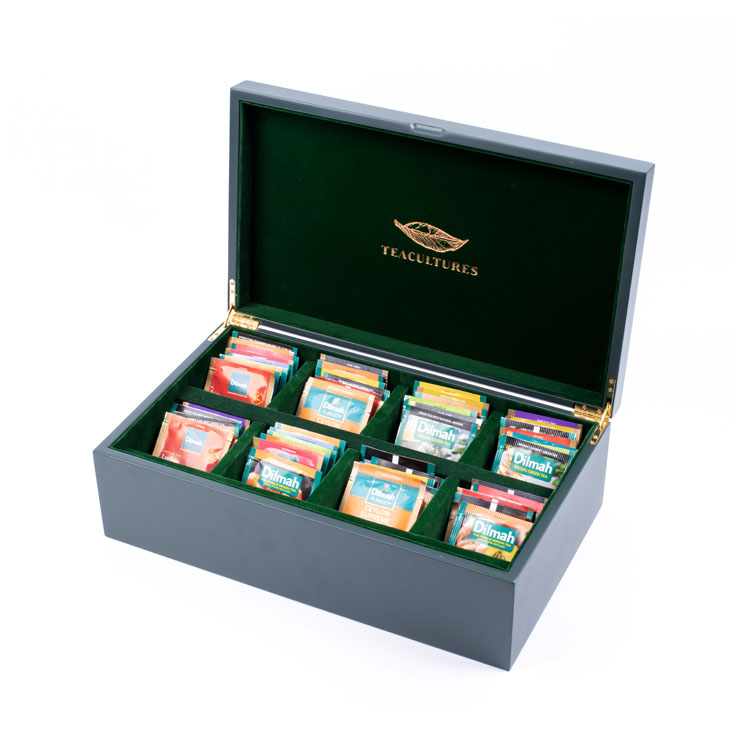
Balancing cost and value starts with selecting the right substrate. You have three primary solution categories to consider.
First, consider SBS (Solid Bleached Sulfate) paperboard. It offers a crisp, pure white surface. This material is best for vibrant, high-fidelity retail printing. It holds CMYK colors exceptionally well.
Second, look at Kraft board. It works beautifully for organic, wellness-focused brands. It communicates sustainability instantly. The raw, textured feel appeals heavily to eco-conscious buyers.
Third, rigid setup boxes provide the ultimate luxury experience. You should reserve these for premium gifting or high-ticket specialty teas. They carry the highest production cost. However, they also deliver the highest perceived value.
Next, evaluate high-impact finishes based on their return on investment. You can choose Spot UV, foil stamping, or embossing. Spot UV adds a glossy highlight to specific areas. It remains relatively affordable. Foil stamping adds metallic elegance but costs significantly more. Embossing creates a tactile 3D effect. Compare the conversion impact of these finishes against their added per-unit cost.
Avoid the common trap of over-engineering. Match your packaging material tier directly to your product's Retail Price (MSRP). This framework helps you maintain healthy profit margins. Do not put an everyday product in a highly expensive box. Use the breakdown below as a guide.
Recommended Substrate | Suitable Finishes | Target Audience |
|---|---|---|
Standard Kraft Board | Minimalist printing, aqueous coating | Eco-conscious, everyday consumers |
SBS Paperboard | Spot UV, Matte lamination | Mainstream premium, retail shoppers |
Rigid Setup Box | Hot foil stamping, Embossing | Gifting, luxury specialty buyers |
Customization involves hidden financial layers. You must understand Minimum Order Quantities (MOQs). Volume tiering heavily affects your unit economics. Printing presses require significant setup time. Spreading this setup cost over 500 units makes each box expensive. Spreading it over 5,000 units drops the price drastically. Ordering the bare minimum often results in prohibitive per-unit costs.
Tooling and setup fees also impact your initial budget. Be prepared for one-time die-plate charges. Custom structural design fees are standard in the packaging industry. Transparently model these upfront capital requirements. Once you pay for a die-plate, subsequent orders become much cheaper. Always ask your vendor to itemize these specific fees.
Logistics and storage create another complex financial dynamic. Consider the difference between folding cartons and rigid boxes. Folding cartons ship flat. They store highly efficiently on standard warehouse racks. Rigid boxes arrive pre-assembled. They essentially ship empty air. This significantly increases dimensional weight charges during transit. Factoring in warehouse space constraints is crucial before committing to a rigid structure.
The prototyping phase is crucial for success. Never skip physical proofs. Skipping this step risks massive production failures. Always order a blank structural sample first. Use it to test your exact product fit. Insert your sachets or pouches. Check the closing mechanism for security. Next, request a printed proof. This verifies your color accuracy. On-screen colors rarely match printed outcomes perfectly.
Shortlisting the right vendor requires strict evaluation criteria. First, evaluate lead times. Domestic production offers speed and easier communication. Overseas production offers better volume pricing but longer transit times. You must bridge your inventory gaps carefully.
Second, establish acceptable quality limits (AQL). Define your defect tolerance clearly upfront. Discuss acceptable margins for minor color shifting. Agree on parameters for potential glue failure. Put this data securely in your manufacturing contract.
Third, prioritize technical communication. You need a vendor who provides direct access to packaging engineers. Relying solely on sales reps leads to technical miscommunication.
Before requesting a formal quote, prepare your specifications. Use this next-step action checklist:
Determine the exact inner dimensions required for your pouches.
Finalize the net tea weight per unit.
Select your preferred substrate material from the evaluation phase.
Calculate your estimated annual volume to negotiate better tier pricing.
Choosing a custom Tea Packaging Box combines brand positioning, product protection, and unit economics. It remains a highly strategic move. Your packaging acts as your silent salesperson. It must perform perfectly on the retail shelf and in the consumer's home.
Remind yourself to weigh the upfront setup costs carefully. Contrast them against long-term operational gains. Retail placement improves. Customer loyalty deepens over time. The initial capital outlay pays compounding dividends.
Take the next evaluation step today. Request a material sample kit from a reputable packaging manufacturer. Book a structural design consultation. Baseline your exact costs early. This careful preparation guarantees a smoother transition to premium custom packaging.
A: Standard MOQs depend entirely on the box style. Folding cartons typically require an MOQ of 1,000 to 2,500 units to achieve viable unit economics. Rigid boxes, which involve more manual labor, often start at 500 units. Ordering below these thresholds usually triggers steep setup penalties.
A: You must specify odor-neutral paperboard and demand FDA-approved, food-safe inks. Cheap adhesives and standard industrial inks release volatile organic compounds (VOCs). These compounds contaminate delicate tea leaves. We also recommend using an inner barrier pouch (like foil or metallized film) for double protection.
A: Domestic production usually takes 3 to 5 weeks after you approve the final physical proof. Overseas production requires 8 to 12 weeks due to ocean freight transit. Always factor in an additional two weeks for the initial prototyping and structural sampling phase.
A: Yes, sustainable options generally carry a slight premium. Standard Kraft board is relatively cost-neutral compared to SBS paperboard. However, specialized compostable materials, FSC-certified papers, and soy-based inks can increase your per-unit cost by 10% to 20%. The trade-off is higher brand loyalty among eco-conscious buyers.
