Tel \ WhatsApp
+1(626)866 1909
+86 185 2005 0589

Author: Site Editor Publish Time: 2026-08-20 Origin: Site

In the luxury sector, the product journey never truly ends at the point of sale. Instead, it seamlessly transitions into the physical unboxing experience. Consumers expect an elevated reveal. A custom Jewelry Packaging Box serves as the tactile bridge. It connects your digital marketing promises directly to physical product reality. This critical asset transforms anticipation into tangible validation.
For procurement managers and brand directors, selecting the right packaging architecture matters. You must balance brand DNA representation effectively. Structural integrity remains equally vital. Furthermore, you need scalable unit economics and highly reliable supply chains. This article explores how strategic packaging drives long-term customer retention. You will learn to map visual identity to material selection accurately. We will also outline robust vendor evaluation frameworks. These insights ensure flawless production execution from design to delivery.
Strategic Alignment: Packaging translates intangible brand values (e.g., heritage, minimalism, sustainability) into physical touchpoints.
Material Matrix: The choice between rigid board, velvet, or eco-friendly composites directly influences perceived product value and dimensional weight costs.
Technical Execution: Specialized logo finishes (embossing, foil stamping) require specific substrate pairings to avoid production failures.
Vendor Evaluation: Transitioning from design to deployment requires assessing manufacturer MOQs, prototyping capabilities, and quality assurance protocols.
High-end jewelry often faces baseline parity across the market. Materials like gold, platinum, and diamonds are universally available. Competitors source from similar global supply chains. Therefore, packaging acts as a primary post-purchase differentiator. It elevates the perceived value instantly. Brands use distinct packaging to stand out in crowded markets. It creates a memorable signature style. When customers hold a beautifully crafted box, they immediately feel the premium quality. This tactile reassurance justifies high price points.
Consumers love sharing their purchases online. Structuring the unboxing experience encourages user-generated content (UGC). A stunning Jewelry Packaging Box looks spectacular on camera. This organic social sharing lowers Customer Acquisition Cost (CAC) significantly. Viewers trust peer reviews far more than traditional ads. Beautiful packaging turns casual buyers into highly vocal brand advocates. It acts as a silent, continuous marketing engine for your business.
Substandard packaging correlates directly to higher return rates. Damaged boxes harm brand perception immediately. Buyers question the authenticity of the jewelry inside if the box feels cheap. Conversely, structurally sound packaging protects your transit margins. It ensures delicate pieces arrive safely at their destination. You avoid costly refunds and negative reviews. A common mistake is treating packaging as an afterthought. You must view it as a critical risk management tool.
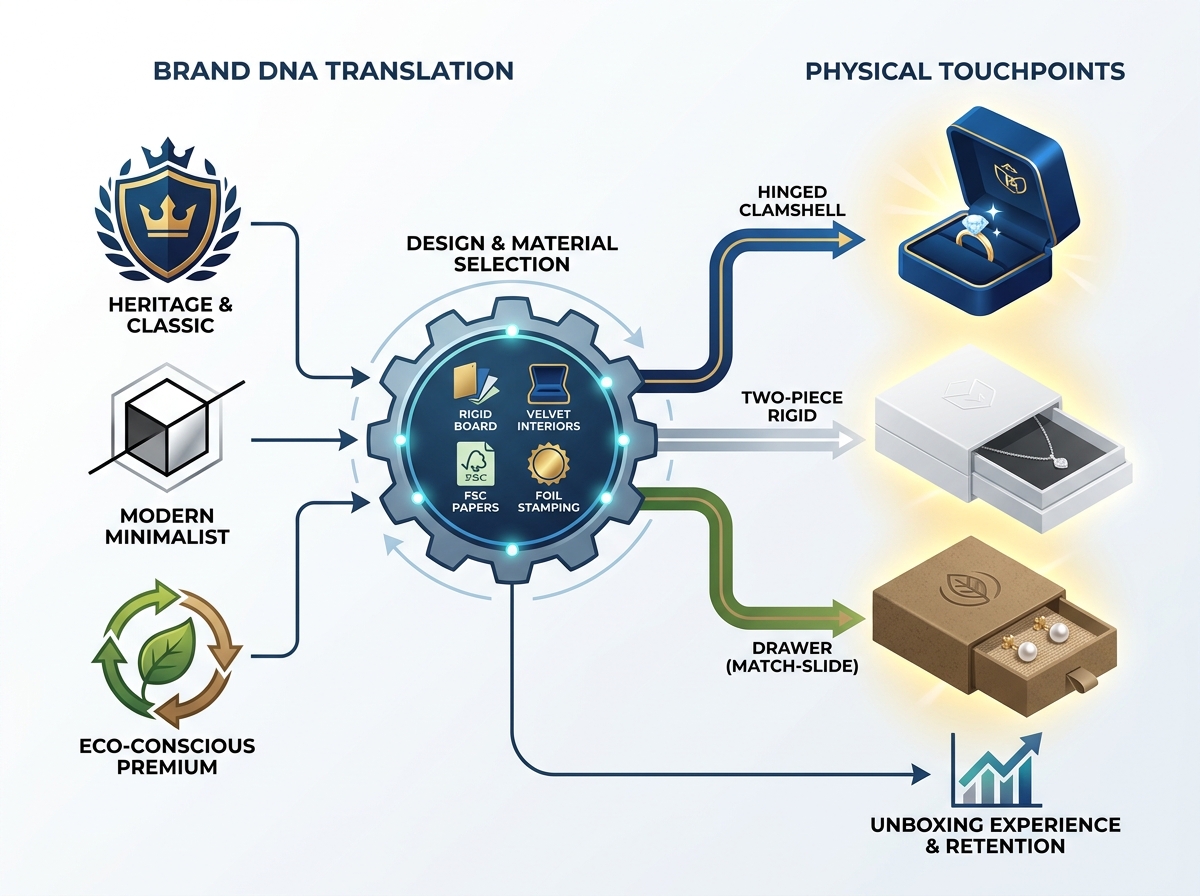
Legacy brands require significant weight and physical resistance. Consumers naturally associate heaviness with high quality. You should use traditional textures to convey rich history. Deep-dyed leatherette offers a timeless, sophisticated appeal. Velvet interiors cushion delicate pieces luxuriously. Brass hinges add an audible click upon closing. This satisfying sound reinforces the premium market positioning. Every interaction confirms the heritage of the brand.
Contemporary brands take a fundamentally different approach. They focus heavily on clean, uninterrupted lines. Matte finishes reduce glare and feel distinctly modern. Monochromatic palettes project quiet confidence and elegance. Hidden magnetic closures maintain a sleek exterior profile. They eliminate visual clutter from clasps or ribbons. This minimalist style appeals strongly to younger affluent demographics. It speaks to a modern interpretation of luxury.
Sustainability no longer means compromising on high-end appeal. You can utilize FSC-certified papers confidently. Recycled rigid boards form remarkably strong foundations. Soy-based inks provide vibrant color saturation effectively. They achieve this without harmful chemical runoffs. Advanced manufacturing retains the rigid, heavy feel consumers expect. Environmentally conscious buyers appreciate this corporate responsibility. It builds deep trust without sacrificing aesthetics.
Signature brand colors increase immediate brand recall immensely. Distinct shades trigger emotional connections before the box even opens. You must maintain strict color consistency across all production batches. Visual retrieval relies on exact Pantone matching. Subtle color variations dilute your brand identity significantly. Accurate color reproduction signals professional competence to the buyer.
Touch sets buyer expectations instantly. You must carefully evaluate the friction of different materials. Soft-touch laminates feel exceptionally warm and inviting. Textured linen papers offer crisp, cool friction against the skin. The temperature of the material matters deeply in luxury retail. These sensory details prep the consumer for the jewelry reveal. They build subconscious anticipation effectively.
Two-piece rigid boxes serve as the industry standard for high-end retail. They offer maximum structural integrity and protection. You gain expansive, flat surfaces for excellent printability. They withstand stacking and rough handling during transit beautifully. Retail staff find them easy to inventory and wrap.
Hinged clamshell boxes remain ideal for engagement rings. They also suit high-value single pieces perfectly. A hinged lid provides a highly controlled, presentational reveal. It forces the viewer to focus entirely on the centerpiece. Spring-loaded hinges keep the lid open at a precise viewing angle.
Drawer boxes support modern brand identities brilliantly. They are highly effective for modular stacking. Retailers love them for dynamic display arrangements. Consumers often repurpose drawer boxes for home jewelry storage. This extends your brand presence in their daily lives indefinitely.
Table: Structural Typologies and Applications
Box Typology | Primary Application | Structural Advantage | Brand Perception |
|---|---|---|---|
Two-Piece Rigid Box | Necklaces, Bracelets, Gift Sets | Maximum stackability, highly printable | Classic, established, reliable |
Hinged Clamshell | Engagement Rings, High-Value Solitaires | Controlled viewing angle, secure closure | Romantic, highly premium, dramatic |
Drawer (Match-Slide) | Earrings, Fashion Jewelry, Modular Sets | Easy retail access, reusable storage | Modern, functional, minimalist |
Foam remains a highly cost-effective interior solution. However, standard foam can degrade and yellow over time. Flocked blister packs offer a velvet-like surface over a plastic mold. These options work best for entry-level luxury lines. They protect well but lack a heavy, premium feel. You should upgrade materials as your price point increases.
Microfiber and suede pouches deliver a truly premium tactile feel. Genuine suede protects against dangerous micro-abrasions perfectly. It also prevents silver tarnish during long international transit times. Many buyers use these durable pouches for personal travel. This creates ongoing utility for the packaging.
Custom-molded inserts require the highest upfront tooling costs. However, they ensure zero product movement during shipping. They are essential for irregularly shaped, high-ticket items. Precision fitment signals bespoke craftsmanship immediately. It shows the customer you engineered the box specifically for that piece.
Foil stamping delivers high-contrast metallic reflection. It catches retail lighting beautifully, drawing the eye. However, you require a high-density board underneath. Soft boards lead to debossing bleed during the stamping process. The foil loses its crisp edges on weak substrates. Always pair hot foil with rigid materials.
Embossing creates a beautiful 3D tactile brand mark. It invites consumers to run their fingers over the logo. These methods are best utilized on uncoated, textured papers. Uncoated surfaces allow for maximum impression depth. The shadow play on an embossed logo looks incredibly sophisticated. It communicates quiet luxury without relying on shiny metals.
Spot UV coating applies a targeted gloss layer. It highlights specific design elements cleanly and subtly. The gloss contrasts sharply against matte backgrounds. This technique is highly cost-effective for modern brands. It adds visual dimension without expensive metal stamping dies. Spot UV works wonderfully for intricate geometric logos.
International shipping exposes packaging to harsh conditions. You must assess rub-resistance vigorously before mass production. Foil flaking risks ruin the unboxing experience entirely. A scratched logo destroys brand equity instantly.
Here are core best practices for durability testing:
Conduct rigorous friction rub tests on all foil stamped areas.
Perform repeated drop tests to check hinge integrity.
Expose samples to extreme humidity chambers to check glue bonds.
Verify that interior dyes do not transfer to the jewelry.
Test magnetic closure strength after hundreds of repeated openings.
You must secure physical sampling before volume commitments. CAD structural samples verify the physical dimensions accurately. Fully finished pre-production samples confirm the final aesthetics and color matching. Skipping this crucial step often leads to massive production failures. Never approve a mass production run based solely on digital renderings.
Modern consumers demand absolute supply chain transparency. When sourcing a reliable Jewelry Packaging Box, you must verify FSC, ISO, or REACH compliance. This is critical for brands making sustainable claims. Hypoallergenic certifications matter deeply for interior fabrics. They ensure sensitive metals remain uncontaminated. Strict compliance protects your brand from PR disasters.
You must establish precise acceptable defect rates (AQL). Define strict parameters for glue line visibility. Check hinge alignment tolerances closely with your vendor. Color-matching consistency across production batches is absolutely mandatory. Small variances degrade brand trust quickly. A rigorous QA protocol separates amateur vendors from true packaging partners.
You must balance unit cost reductions carefully against practical reality. High volumes lower the per-unit manufacturing price. However, they consume valuable warehousing space quickly. They also tie up vital cash flow for months. Evaluate your actual storage capacity before ordering massive quantities. Phased delivery schedules often solve space constraints.
Custom shapes require upfront tooling investments. Proprietary inserts need unique metal dies for precision cutting. Understanding these initial costs is essential for accurate budgeting. Utilizing manufacturer-owned standard dies saves significant money. It also accelerates your time to market considerably. Discuss standard mold options with your vendor early.
Chart: Packaging Production Scaling Factors
Factor | Standard Molds | Custom Molds | Business Impact |
|---|---|---|---|
Upfront Tooling Cost | Zero | High | Affects initial cash flow |
Lead Time | 2-4 Weeks | 6-8 Weeks | Determines time to market |
Brand Exclusivity | Low | High | Drives long-term brand equity |
A luxury jewelry box acts as a multi-dimensional brand asset. It secures the delicate product effectively during complex transit. It validates the high premium price point immediately upon touch. Ultimately, it reinforces your core brand identity in a physical format. The unboxing moment represents the absolute peak of consumer excitement. You must engineer this moment with precision.
Take immediate action to elevate your unboxing experience. First, audit your current packaging defect rates closely. Second, define your core brand tactile requirements clearly. Finally, request structural white-samples from shortlisted packaging engineers. Tangible tests always reveal the truth behind digital renderings. Invest in packaging wisely, and you will secure lasting customer loyalty.
A: Variables include dimensional weight (DIM) and structural rigidity. Heavy wooden boxes increase shipping fees dramatically. Conversely, lightweight rigid boards with custom inserts balance protection with optimized freight costs. Proper sizing eliminates dead space. This reduces DIM charges while keeping the product completely secure during transit.
A: Yes. Advanced manufacturing allows FSC-certified recycled materials to be paired with debossing. You can also use textured laminates effectively. This achieves a premium tactile experience without virgin plastics. Soy-based inks and water-based glues ensure environmental compliance while maintaining the heavy, structured feel luxury buyers expect.
A: Lead times typically range from 2–4 weeks for prototyping. Mass production generally takes 4–8 weeks. The exact timeline depends on the complexity of logo finishes. Global supply chain routing and material availability also influence delivery. Always factor in transit times from the manufacturing facility.
A: Standard sizes reduce upfront tooling costs significantly. They also shorten lead times, making them ideal for testing new product lines. However, custom molds are required when your proprietary brand identity demands exact fitment. Unique product shapes often necessitate custom inserts to prevent transit damage.
