Tel \ WhatsApp
+1(626)866 1909
+86 185 2005 0589

Author: Site Editor Publish Time: 2026-08-06 Origin: Site

In the highly competitive fragrance industry, initial perceived value relies heavily on visual and tactile presentation. Your packaging acts as a critical touchpoint before a customer even experiences the scent. Designing effective Perfume Packaging Boxes requires balancing distinct aesthetic differentiation, structural protection for fragile glass, and scalable unit economics. Poorly designed containers invite costly transit damage and negative customer reviews. Conversely, overly complex structures destroy your profit margins on the assembly line.
This guide provides a clear, technical framework for brands actively evaluating their packaging strategies. You will learn how to transition seamlessly from initial design concepts to manufacturing-ready solutions. We will explore structural material selection, custom insert engineering, and premium finishing techniques. By applying these specific insights, you can navigate supplier capabilities efficiently and bring a secure, luxurious product to the retail market.
Structural integrity directly impacts profit margins by reducing transit damage and return rates.
Material selection dictates both luxury perception and sustainability compliance.
Precision-engineered inserts are non-negotiable for glass bottle security and premium unboxing.
High-end finishes require careful evaluation against scalability and unit costs.
Evaluating a manufacturing partner requires looking beyond price to their prototyping capabilities and MOQ flexibility.
Fragile glass bottles and intricate atomizers remain highly susceptible to transit damage. Rough shipping environments often lead to cracked glass and leaked liquids. These incidents trigger high return rates. They also inflict lasting damage on your brand reputation. We must evaluate structural features strictly based on their protective outcomes.
Wall thickness serves as the primary defense against external impact. You should assess paperboard weight based on your specific bottle’s weight and unique center of gravity. Most standard folding cartons lack the rigidity needed for heavy glass. We recommend utilizing 1000gsm to 1500gsm rigid boards for premium fragrance lines. This thick greyboard core absorbs shock effectively during warehouse handling and final mile delivery.
Different box styles offer varying degrees of protective merits. You must compare these styles carefully to find the right balance between security and unboxing elegance.
Structural Box Style Comparison
Box Style | Protective Rating | Primary Advantages | Common Applications |
|---|---|---|---|
Two-Piece Lid-and-Base | High | Excellent vertical crush resistance. Dual walls provide double protection. | Heavy, wide-bottomed glass bottles. |
Magnetic Closure Book-Style | Medium-High | Secure hinged lid prevents accidental opening. Easy to incorporate rigid inserts. | Luxury retail presentations and gift sets. |
Drawer (Slide) Boxes | Medium | Thick outer sleeve protects the inner tray. Friction keeps the tray secure. | Minimalist brands and discovery sets. |
Implementation involves notable physical risks. Designing a box leaving too much internal clearance creates product rattle. Rattling leads directly to surface scratches and broken pump mechanisms. Conversely, engineering a box too tightly complicates the manual assembly process. Workers will struggle to insert the bottles quickly. This bottleneck dramatically increases your labor costs on the packaging line.
Material selection dictates consumer perception immediately upon touch. You must match the retail price point of your product directly with the tactile experience of the Perfume Boxes. Consumers subconsciously evaluate the weight, texture, and finish of the paperboard before forming an opinion on the fragrance itself.
We divide premium material solutions into two distinct categories based on brand positioning:
Luxury and Premium Solutions: These rely on tactile differentiation. Textured specialty papers, such as linen-embossed or leatherette wraps, communicate high value. Soft-touch laminates provide a velvety feel. Rigid greyboard forms an unyielding foundation. These elements collectively signal a prestige product.
Eco-Friendly and Sustainable Solutions: Modern brands frequently target environmentally conscious demographics. FSC-certified kraft paper ensures responsible forestry practices. Recycled folding cartons reduce raw material dependency. Soy-based inks minimize volatile organic compounds (VOCs) during the printing process.
Compliance-aware thinking represents a crucial aspect of material selection. Many brands fail to consider long-term legibility. Ensure your chosen substrates can clearly display mandatory regulatory information. Regulatory bodies strictly mandate the inclusion of ingredient lists, flammability warnings, and tracking batch codes.
Porous materials like uncoated kraft paper absorb liquid inks rapidly. This absorption often causes small text to bleed and blur. Glossy or heavily textured papers might reject standard inkjet batch coding. You must test ink adhesion thoroughly. Critical warning labels cannot smudge during transit or fade under retail lighting over time.
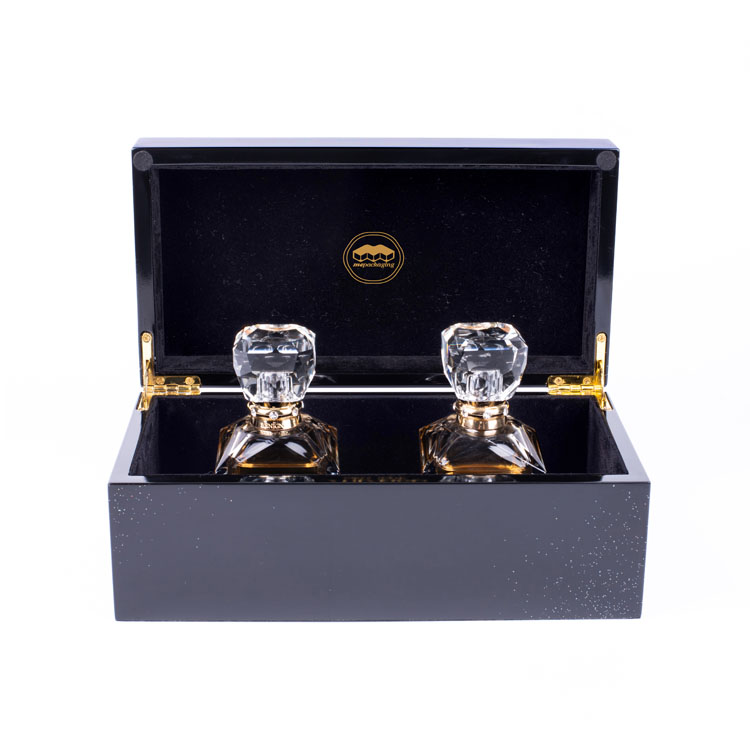
A premium exterior proves entirely wasted if the interior fails. We cannot securely cradle the bottle if we ignore insert engineering. A loose bottle rolling inside a beautiful box leads directly to a disconnected, cheap unboxing experience. Custom inserts represent a non-negotiable feature for fragile glass security.
We see three primary solution approaches dominating the market today:
EVA Foam and Flocked Sponge: This approach delivers the highest impact protection available. EVA foam boasts high density. It easily supports heavy or unusually shaped glass. Applying a flocked velvet top layer adds a distinct luxury feel.
Molded Pulp: This option aligns perfectly with strict sustainability mandates. Manufacturers shape recycled paper slurry directly around the bottle's contours. It is highly protective, biodegradable, and eco-friendly.
Die-cut Paperboard: This represents the most cost-effective solution. Using engineered folded cardboard offers excellent scalability. It remains fully recyclable. However, it requires highly precise folding structures to suspend the bottle safely away from the box walls.
Implementation considerations demand strict attention to detail. Dimensional tolerances must remain exact down to the millimeter. Glass manufacturing involves slight variance. A bottle from one batch might be fractionally larger than another.
You must highlight the absolute necessity of sending physical, empty glass bottles directly to your packaging manufacturer. Relying solely on 3D CAD files frequently results in poor fits. The manufacturer uses the physical bottle to test and ensure a perfect friction-fit custom cavity. This physical verification prevents the bottle from shifting during transit while ensuring it remains easy for the consumer to remove.
Visual embellishments elevate standard paperboard into coveted retail objects. Popular solution categories include Spot UV coatings, hot foil stamping, blind embossing or debossing, and metallic inks. These techniques add depth, contrast, and light interaction to your Perfume Packaging Boxes.
Shortlisting these finishes requires specific logic based on your core brand identity. You should avoid applying every available technique simultaneously. Minimalist, modern brands may rely solely on blind debossing. Pressing a logo deep into thick, uncoated paper creates subtle, elegant shadows. Conversely, luxury legacy brands might require complex, multi-color foil stamping to recreate intricate crests or historic logos.
Scalability introduces significant cost and production risks. We constantly warn brands against the trap of "over-finishing." Each additional finishing process requires a completely separate machine pass on the factory floor. Applying CMYK ink, followed by matte lamination, then gold foil, and finally Spot UV means the paperboard runs through four different machines.
Every single machine pass increases your baseline reject rate. Misalignment (registration errors) happens frequently when layering finishes. This complexity drastically increases your final unit cost. It also extends your production lead time. A simple, well-executed single finish often looks more sophisticated and remains infinitely more scalable for mass production.
Evaluating a manufacturing partner requires looking far beyond the initial quoted price. You must vet a supplier based on their technical capabilities and flexibility before ever committing to mass production. This vetting process heavily relies on the prototyping phase.
Implementation realities during prototyping require strict client demands. You should always demand a "blank dummy." This unprinted, structural prototype allows you to test the physical fit of your bottle. You can perform drop-durability tests. You can verify hinge strength and closure snap. Finding a structural flaw at this stage costs nothing to fix.
Furthermore, you must demand a digital or physical color proof. Paper absorbs ink very differently than a backlit digital screen displays it. A vibrant blue on your monitor might look dull and muddy on uncoated recycled paper. Verifying brand color accuracy on your chosen material prevents expensive mass-production disasters.
We must address transparent assumptions regarding Minimum Order Quantities (MOQs). Navigating these numbers dictates your cash flow strategy. Some suppliers advertise lower MOQs, offering runs of 500 units. These small batches benefit lean startup brands testing new markets.
However, unit economics heavily favor production runs exceeding 3,000 to 5,000 units. Packaging involves significant fixed costs. Manufacturing steel die-cutting plates and calibrating heavy printing presses requires the same labor and time regardless of the order size. Amortizing these fixed setup costs across 5,000 units drastically lowers the price per box. You must balance your immediate budget constraints against the long-term profitability of scaling up.
Customizing perfume presentation is fundamentally an exercise in risk mitigation and value creation. You must engineer structural defenses to prevent glass breakage while simultaneously designing an exterior that commands premium retail pricing. By prioritizing exact tolerances for custom inserts and selecting scalable finishing techniques, you ensure a consistent unboxing experience for every customer.
We recommend taking specific, action-oriented next steps to refine your strategy:
Audit your current transit return rates due to breakage or leakage to identify immediate structural weaknesses.
Evaluate your brand positioning strictly to align material choices with your target retail price point and sustainability goals.
Request a structural blank dummy from a qualified packaging manufacturer to physically verify the friction-fit of your specific glass bottle.
Analyze the unit economics of your next production run, comparing the cost difference between low MOQs and optimized 5,000-unit batches.
A: Timelines vary based on structural complexity and finishes. Generally, expect 1 to 2 weeks to develop and approve physical prototypes. Once you approve the final proof, mass production typically requires 3 to 5 weeks. Shipping times add further delays, depending on your geographic location and chosen freight method.
A: Using standard-sized containers carries significant risks. Standard sizing leaves internal gaps. Fragile glass bottles will rattle, shift, and potentially break during transit. You absolutely need custom-engineered inserts to hold your uniquely shaped bottle securely in place.
A: Suggesting luxury on a budget relies on structural simplicity combined with a single premium finish. Use a standard box shape but invest in a high-quality textured specialty paper. Pair this tactile surface with a simple hot foil stamped logo. This approach avoids complex multi-pass printing costs while still feeling exceptionally premium.
